How Does Artificial Intelligence Work with AutoTRAX DEX?
AutoTRAX DEX takes electronic design to an exciting new level by integrating Artificial Intelligence (AI) into the design process, making it easier, faster and more intuitive to create electronic components, schematic symbols, PCB footprints and 3D models.
At the heart of this intelligent functionality is DEX-AI, which uses a Large Language Model (LLM) to provide a powerful, natural-language interface to your electronic design software.
Instead of spending hours searching through manufacturers' datasheets, identifying pin assignments, checking package specifications and manually entering component information, you can simply tell DEX-AI what you want to achieve using ordinary, everyday language.
DEX-AI interprets your request and helps transform it into structured technical information that AutoTRAX DEX can use in its electronic design environment.
What Is the DEX-AI Large Language Model?
A Large Language Model (LLM) is an advanced type of artificial intelligence trained on enormous quantities of text, technical documentation, computer code and other information.
This training enables an LLM to understand questions, interpret instructions, recognise technical terminology and generate useful responses in natural language.
In AutoTRAX DEX, this technology provides an intelligent bridge between you and the software.
You don't need to learn complicated commands or remember where every function is located. Instead, you can describe what you want to do, and DEX-AI can help interpret your instructions and provide the information required to complete the task.
Think of DEX-AI as an intelligent electronic design assistant, available to help you with component information, technical specifications and the creation of new electronic parts.
An Example: Creating a New Electronic Component
Imagine that you are designing a circuit using a Zilog Z80180 microprocessor.
Traditionally, creating a new component might involve downloading the manufacturer's datasheet, locating the pinout diagrams, identifying the available IC packages and carefully entering all the information needed to construct the schematic symbol and PCB footprint.
Depending on the complexity of the device, this could be a time-consuming process.
With DEX-AI, you can begin with a simple request:
"Find the pinout of a Zilog Z80180 microprocessor, identify all supported packages, and generate the schematic symbols, PCB footprints and 3D models."
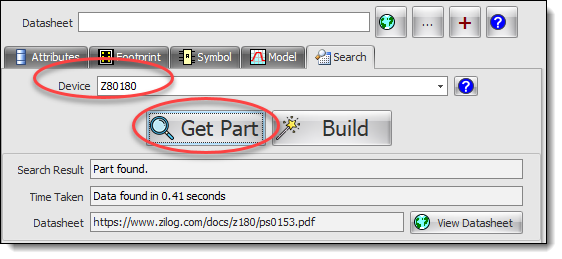
Find the pinout of a Zilog Z80180
That's it! You've described what you want using plain English.
DEX-AI can then help AutoTRAX DEX carry out a series of tasks:
1.Identify the electronic component. Recognise the Zilog Z80180 microprocessor and determine the relevant manufacturer and device family.
2.Locate technical information. Help identify the appropriate manufacturer's datasheets and supporting documentation using available information-retrieval tools.
3.Identify available packages. Determine the package variants supported by the manufacturer, such as PLCC or QFP, where applicable.
4.Extract pin assignments. Organise the pin numbers, signal names, power connections, ground connections and alternative pin functions into structured information.
5.Determine package specifications. Extract relevant mechanical information, including package dimensions, lead pitch and other footprint requirements where these are documented.
6.Prepare schematic symbols. Supply the pin information required by AutoTRAX DEX to construct the corresponding schematic symbols.
7.Prepare PCB footprints. Supply package and mechanical information for generating the appropriate PCB land patterns.
8.Support automatic 3D model generation. Provide the package specifications required by AutoTRAX DEX to create a three-dimensional representation of the component.
The resulting information can be passed to AutoTRAX DEX, where its component creation tools can process it to generate the electronic design elements.
What previously required considerable manual research and data entry can potentially be accomplished much more quickly, leaving you free to concentrate on the actual circuit design.
For further information, see:
Creating a New Part in AutoTRAX DEX
An Important Note About Accuracy
Although DEX-AI is an extremely useful design assistant, it is important to understand that artificial intelligence does not automatically guarantee the accuracy of the technical information it produces.
Like other large language models, DEX-AI can occasionally generate incorrect, incomplete or outdated information. For example, it might misidentify a package variant, incorrectly assign a pin function or provide mechanical dimensions that do not match the manufacturer's specifications.
An LLM does not inherently verify its answers against official manufacturer documentation. Reliable retrieval, extraction and validation require suitable tools and appropriate checks.
The manufacturer's official datasheet must always be treated as the authoritative source of technical information.
Before using an AI-generated component in a production design, you should verify its pin assignments, electrical characteristics, package dimensions and PCB footprint against the relevant manufacturer's documentation.
This is particularly important for complex integrated circuits, where even a single incorrect pin assignment or footprint dimension could result in a non-functional PCB.
DEX-AI is intended to make electronic design more productive and convenient, not to replace sound engineering judgement or the need for technical verification.
Bringing Artificial Intelligence and Electronic Design Together
The real advantage of DEX-AI is the combination of two powerful technologies: the natural-language understanding of a large language model and the integrated electronic design capabilities of AutoTRAX DEX.
DEX-AI helps interpret your requirements and organise technical information, while AutoTRAX DEX provides the specialised tools needed to turn that information into practical electronic designs.
This approach can significantly reduce repetitive work, simplify component creation and make sophisticated electronic design tools more accessible to both newcomers and experienced engineers.
Whether you are creating a simple operational amplifier, a microcontroller or a complex microprocessor, DEX-AI offers a more natural and convenient way to work with electronic component information.
You describe what you want to create. DEX-AI helps obtain and organise the information. AutoTRAX DEX turns that information into electronic design components.
It's another step towards making electronic design faster, smarter and more enjoyable.
To learn more about the underlying technology, see:
The DEX-AI Large Language Model (LLM)